- Telephone number: +81-3-3962-0415
- FAX: Log in to display
- Website
- Basic Info
- Equipment
- Technology & Products
- Movie
- History, Philosophy & Quality
- EMIDASBLOG
- Map / HQ


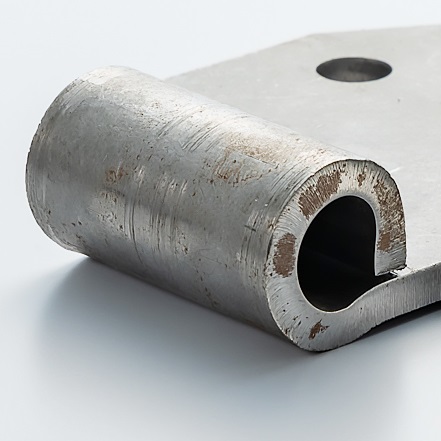
Curl Bending
Industry
Automobile (trial production)
Automobile (mass production)
Specifications
- Materials:Iron
- Lots:1,000 - 10,000 lots
- Precision: ---
Conventional technologies/differences from other companies
【Causes of Unstable Hinge Durability】
Hinges are critical for door and cover operation, but insufficient precision or strength in the rotational shaft can cause looseness, noise, and premature wear.
A key issue is the machining accuracy of the “rolled section” forming the shaft. Roundness, clearance, and material integrity (e.g., cracks or excessive work hardening) directly affect lifespan.
Curl bending is a common method used to form this rolled section.
【What is Curl Bending】
〈Plastic forming that rolls sheet material into a cylindrical shape〉
Curl bending rolls the edge of a sheet into a cylindrical shape. In hinges, a pin passes through this section to form a rotational mechanism. Unlike simple L- or U-bends, the material forms nearly a full circle.
The outer surface is under tension and the inner under compression, requiring careful control of:
・Inner diameter
・Bend radius
・Springback
・Material hardness
High precision is essential for smooth, reliable rotation.
【Technical Points for Hinge Curl Bending】
〈Ensuring roundness and coaxiality〉
Hinges combine multiple curled sections with a single pin. Misalignment can cause stiff rotation or assembly issues. Precision is achieved through:
・Accurate hole positioning and outer profile
・Multi-stage forming for load distribution
・Die compensation for post-forming variations
Kawamura Kikai Co., Ltd. operates 50 press machines (10t–500t) and handles deep drawing, bending, punching, trimming, and complex 3D forming like curl bending.
【Process Design to Prevent Cracking and Collapse】
〈Avoid finishing in a single process〉
Forming the cylinder in one step can cause outer cracks or inner collapse, reducing roundness. Solutions include:
・Gradual curling over multiple stages
・Stabilizing the inner diameter with die geometry
・Adding caulking or corrective steps as needed
Multi-stage process design is essential.
【Applications of Curl Bending】
Curl bending is used beyond hinges, in components such as:
・Rotational bearing parts
・Pin-retention brackets
・Clamp components for wiring
・Hinge sections of safety covers
These are functional areas for movement and retention. Shape accuracy directly affects performance and reliability.
【Key Criteria for Considering Curl Bending】
〈Manufacturing difficulty is determined at the design stage〉
Difficulty cannot be judged from drawings alone. Important factors include:
・Sheet thickness vs. inner diameter
・Material ductility
・Required rotational torque and clearance
・Integration with subsequent processes
Considering manufacturability from the design stage ensures stable and efficient mass production.
【Summary】
For hinges and other rotational components, the precision of curl bending greatly affects lifespan and operational feel. It is not just bending; plastic forming technology and proper process design are crucial.
If there are issues like looseness, assembly defects, or new rolled structures are being considered, reviewing the forming method early is highly effective.
【Contact Information】
Kawamura Kikai Co., Ltd.
Head Office: 2-4 Shimizu-cho, Itabashi-ku, Tokyo 【Composite Division】
Hanazono Factory: 10 Kitane, Fukaya-shi, Saitama 【Metal Press Division】
Website: https://www.kawamura-kikai.co.jp
Inquiry / Quotation: https://www.kawamura-kikai.co.jp/contact/
Please mention that you saw us on “Emidas” when making your inquiry.


Company info
| Company name | Kawamura Kikai Co., Ltd. | EMIDAS Member Number | 105383 |
|---|---|---|---|
| Country | Japan | Street address |
Itabashi-ku Tokyo Japan |
| Telephone number | +81-3-3962-0415 | Fax number | Log in to display |
| Employees | 64,000,000 JPY | Annual sales | |
| Employees | 50 | Person in charge | 河村 護 |
| Type of manufacturing | Industrial machinery / Transportation equipment | ||
| Primary clients |
|
||