- Telephone number: +81-3-3962-0415
- FAX: Log in to display
- Website
- Basic Info
- Equipment
- Technology & Products
- Movie
- History, Philosophy & Quality
- EMIDASBLOG
- Map / HQ


Deep Drawing Processing
Industry
Automobile (trial production)
Lighting equipment
Household goods
Specifications
- Materials:Iron
Steel - Lots:1,000 - 100,000 lots
- Precision: ---
Conventional technologies/differences from other companies
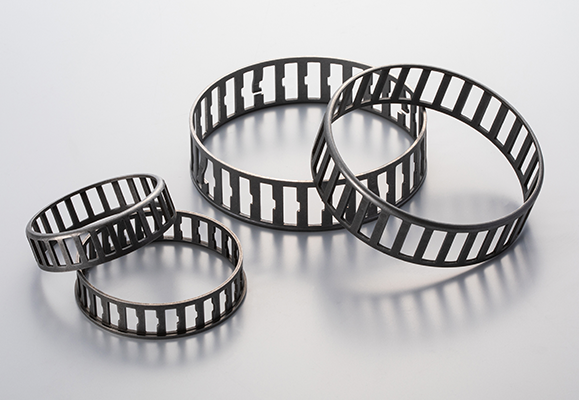
〈Photo: Side holes are also drilled〉
【Issues with Material Yield in Deep Drawing】
Deep drawing is a typical sheet metal forming process used to produce cylindrical or case-shaped components. However, manufacturing often faces issues such as:
・Uneven thickness during deep drawing
・Cracking at the bottom or shoulder areas
・Earing and wrinkling
・Large amounts of scrap after blanking
With rising material costs, scrap handling has become a critical factor affecting overall product competitiveness.
【What Is Deep Drawing】
〈Plastic forming that transforms sheet metal into 3D shapes〉
Deep drawing forms cup- or cylindrical shapes by pressing sheet metal with a punch and die.
Stable deep drawing requires:
・Proper blank diameter design based on material properties
・Optimization of blank holder force
・Appropriate punch and die radii (R)
・Controlled lubrication conditions
Kawamura Kikai Co., Ltd. operates 50 press machines (10–500 t) and supports processes such as deep drawing, bending, blanking, and trimming, backed by over 70 years of metal press expertise.
【Multi-Stage Scrap Utilization】
〈Maximizing material usage〉
The company reuses scrap from the first product to produce additional parts, sometimes up to four stages. Through optimized blank design and process planning, materials are used more efficiently while maintaining forming quality.
【Thickness Control Technology】
〈Preventing localized thinning〉
To prevent localized thinning, the company applies:
・Radius (R) design to control material flow
・Multi-stage forming to distribute forming loads
・Fine adjustment of blank holder force
・Process planning based on prior deformation history
These methods help achieve uniform thickness and stable product quality.
【Applications】
Typical deep-drawn components include:
・Motor cases
・Cover parts
・Cylindrical brackets
・Various housing components
Uniform thickness improves both appearance and durability, while scrap reuse enhances material yield and cost efficiency.
【Key Considerations When Evaluating Deep Drawing】
〈From single-part optimization to system optimization〉
Important factors include:
・Balance between required depth and sheet thickness
・Material strength and ductility
・Connection with downstream processes
・Potential improvement in material yield
If multiple parts can be produced from the same material sheet, blank layout and dimensional relationships should be optimized from the early design stage.
Because the company designs and manufactures dies in-house, it can quickly implement shape modifications and process improvements during prototyping, enabling efficient transition to mass production.
【Summary】
Deep drawing requires precise material flow control. By combining uniform thickness forming with multi-stage scrap utilization, manufacturers can improve material efficiency while maintaining product quality.
【Contact Information】
Kawamura Kikai Co., Ltd.
Head Office: 2-4 Shimizu-cho, Itabashi-ku, Tokyo 【Composite Division】
Hanazono Factory: 10 Kitane, Fukaya-shi, Saitama 【Metal Press Division】
Website: https://www.kawamura-kikai.co.jp
Inquiry / Quotation: https://www.kawamura-kikai.co.jp/contact/
Consultations are available from the early design stage for deep drawing and material reuse–oriented process design. Sharing drawings or current issues will help identify the optimal manufacturing approach.


Company info
| Company name | Kawamura Kikai Co., Ltd. | EMIDAS Member Number | 105383 |
|---|---|---|---|
| Country | Japan | Street address |
Itabashi-ku Tokyo Japan |
| Telephone number | +81-3-3962-0415 | Fax number | Log in to display |
| Employees | 64,000,000 JPY | Annual sales | |
| Employees | 50 | Person in charge | 河村 護 |
| Type of manufacturing | Industrial machinery / Transportation equipment | ||
| Primary clients |
|
||