- Telephone number: +81-3-3962-0415
- FAX: Log in to display
- Website
- Basic Info
- Equipment
- Technology & Products
- Movie
- History, Philosophy & Quality
- EMIDASBLOG
- Map / HQ


Types of CFRTP Composite Intermediate Materials and Key Selection Points
Industry
---
Specifications
- Materials: ---
- Lots: ---
- Precision: ---
Conventional technologies/differences from other companies
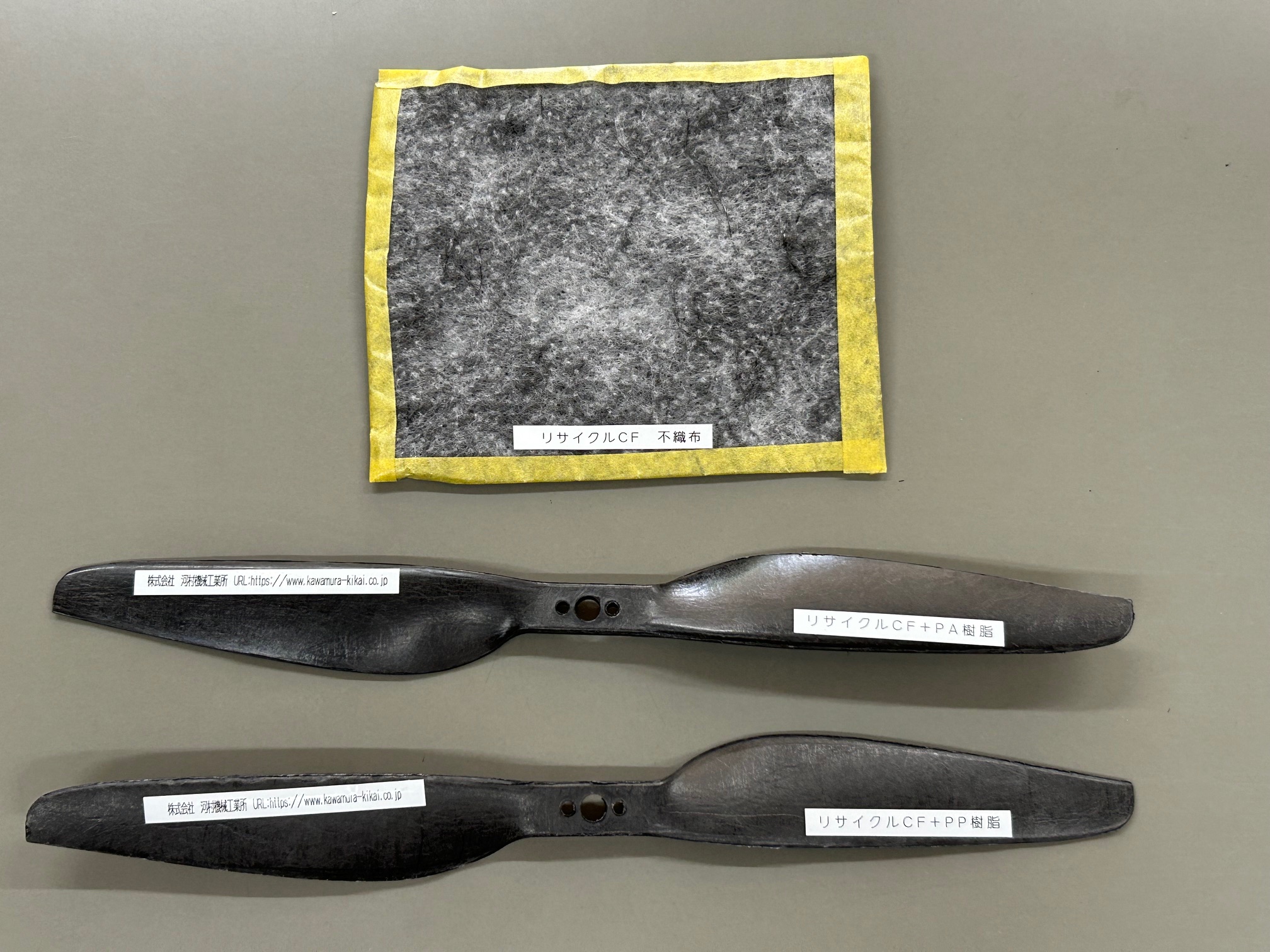
The molding performance and cost of CFRTP (Carbon Fiber Reinforced Thermoplastics) vary significantly depending on the selection of intermediate materials. Intermediate materials are semi-finished materials combining carbon fiber and resin, and they directly affect moldability, surface appearance, and mechanical properties.
Kawamura Kikai Co., Ltd. supports a wide range of intermediate materials and proposes optimal selections based on application requirements and cost targets.
Below is an overview of intermediate material types, characteristics, and equipment capabilities.
【Representative Types of Intermediate Materials】
・UD tape: A tape-shaped material with fibers aligned in one direction. Enables strength design in the tensile direction.
・Chopped material: Flake- or mat-shaped material using short fibers. Easily conforms to complex geometries.
・Nonwoven fabric: Fibers randomly oriented. Provides balanced strength in all directions.
・Commingled yarn: Hybrid yarn mixing carbon fiber and resin fiber. Excellent moldability.
・Semi-preg: Partially resin-impregnated material. Easier to balance performance and cost.
・Prepreg: Fully and uniformly resin-impregnated high-performance material. Excellent surface quality and mechanical properties.
【Cost Considerations】
Costs vary depending on the type of intermediate material. UD tape and nonwoven fabrics are relatively cost-effective and suitable for mass production. Prepreg and chopped sheet materials generally fall into a higher cost range. Selecting the appropriate material based on required performance and budget is essential.
【Compatibility with Processing Methods】
Kawamura Kikai Co., Ltd. supports both hot press and cold press molding methods.
Hot press molding accommodates a wide variety of intermediate materials and is suitable for parts requiring high surface quality or sufficient resin impregnation.
Cold press molding enables high-speed forming of preheated materials and is suitable for deeper geometries.
The optimal process is selected according to product shape and appearance requirements.
【Application Examples】
・Thin rib components requiring high strength: Orientation design using UD tape
・Three-dimensional complex shapes or deep drawing: Nonwoven fabrics or chopped materials
・Appearance-focused components: Prepreg
・Cost-priority mass production parts: Combination of nonwoven fabric and UD tape
【Equipment Capabilities】
The facility is equipped with presses up to 200 tons and supports molding temperatures up to approximately 400°C. The maximum mold size is 1200 × 1500mm, and products up to approximately 500 × 500mm can be molded.
During the prototyping stage, A4-sized flat plate molds are used for efficient material comparison and condition verification. While machining and assembly are not handled in-house, collaboration with partner companies enables secondary processing support.
【Summary】
CFRTP intermediate materials are a critical factor influencing both performance and cost. By selecting the appropriate material and molding method based on application requirements, it is possible to optimize weight reduction, rigidity, surface quality, and cost.
A step-by-step approach—from prototyping to mass production—ensures efficient and reliable product development.
【Contact Information】
Kawamura Kikai Co., Ltd.
Head Office: 2-4 Shimizu-cho, Itabashi-ku, Tokyo 【Composite Division】
Hanazono Factory: 10 Kitane, Fukaya-shi, Saitama 【Metal Press Division】
Website: https://www.kawamura-kikai.co.jp
Inquiry / Quotation: https://www.kawamura-kikai.co.jp/contact/
Please mention that you saw us on “Emidas” when making your inquiry.


Company info
| Company name | Kawamura Kikai Co., Ltd. | EMIDAS Member Number | 105383 |
|---|---|---|---|
| Country | Japan | Street address |
Itabashi-ku Tokyo Japan |
| Telephone number | +81-3-3962-0415 | Fax number | Log in to display |
| Employees | 64,000,000 JPY | Annual sales | |
| Employees | 50 | Person in charge | 河村 護 |
| Type of manufacturing | Industrial machinery / Transportation equipment | ||
| Primary clients |
|
||