- Telephone number: +81-3-3962-0415
- FAX: Log in to display
- Website
- Basic Info
- Equipment
- Technology & Products
- Movie
- History, Philosophy & Quality
- EMIDASBLOG
- Map / HQ


Lightweight and High-Rigidity Drone Components Achieved Through Foam Molding × CFRTP
Industry
---
Specifications
- Materials: ---
- Lots: ---
- Precision: ---
Conventional technologies/differences from other companies
In the development of transportation equipment and drone components, achieving both weight reduction and high rigidity is always a critical challenge. Molding that combines CFRTP (Carbon Fiber Reinforced Thermoplastic) with foam materials is gaining attention as an effective solution. Kawamura Kikai Co., Ltd. is working on CFRTP molding using foam cores to develop lightweight yet highly rigid components.
【Concept of Foam Molding】
In this method, a foam material is used as the core, and CFRTP is laminated on the upper and lower sides before press molding. The key challenge is achieving stable bonding without crushing the foam core. By optimizing the combination of foam types and resin properties, as well as setting appropriate heating, pressurization, and cooling conditions, highly reproducible molding has been achieved.
【Weight Reduction Effect】
In prototype testing, combining foam with CFRTP molding resulted in approximately 30% weight reduction compared to solid CFRTP molded products. This is an effective way to reduce weight while maintaining component rigidity, making it particularly suitable for drone parts where payload capacity and energy efficiency are critical.
【Prototype Example: Drone Blade】
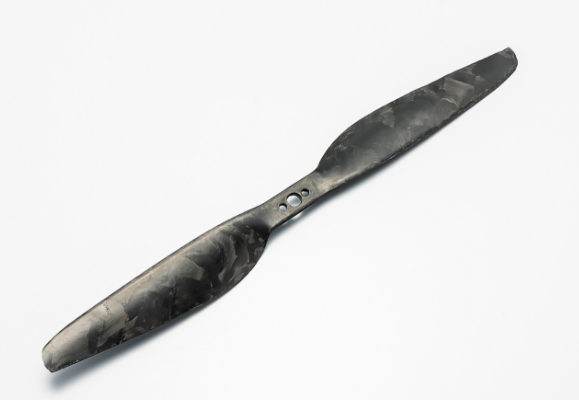
In a prototype targeting a 255mm-class blade shape, molding was successfully completed while retaining the foam core. Fiber orientation was aligned with the stress direction of the blade to ensure torsional rigidity. The finished product was refined through trimming and hole drilling, and dimensional accuracy was verified using a 3D coordinate measuring machine.
【Prospects for Mass Production】
Applying foam molding to drone components is expected to extend flight time and improve flight stability. By further optimizing molding conditions and material selection, development aimed at mass production is feasible. For mass production, considerations such as stable foam supply and optimized cooling conditions are also being addressed.
【Equipment and Capabilities】
The facility is equipped with presses up to 200t and supports molding temperatures up to approximately 400°C. Mold sizes up to approximately 1200×1500mm and product sizes up to approximately 500×500mm can be accommodated. Condition setting and comparative testing using A4-size flat plate molds are also available. Inspection is conducted using 3D coordinate measuring machines and image dimension measuring systems to ensure molding quality. Secondary processing is not handled in-house; however, collaboration with partner companies enables machining and assembly support.
【Summary】
The combination of foam molding and CFRTP is a technology that achieves both lightweight construction and high rigidity. It holds significant potential, particularly in fields such as drones where weight reduction and durability are essential. Kawamura Kikai Co., Ltd. provides an integrated development system from prototyping and evaluation to mass production planning in cooperation with partner companies.
【Contact Information】
Kawamura Kikai Co., Ltd.
Head Office: 2-4 Shimizu-cho, Itabashi-ku, Tokyo 【Composite Division】
Hanazono Factory: 10 Kitane, Fukaya-shi, Saitama 【Metal Press Division】
Website: https://www.kawamura-kikai.co.jp
Inquiry / Quotation: https://www.kawamura-kikai.co.jp/contact/
Please mention that you saw us on “Emidas” when making your inquiry.


Company info
| Company name | Kawamura Kikai Co., Ltd. | EMIDAS Member Number | 105383 |
|---|---|---|---|
| Country | Japan | Street address |
Itabashi-ku Tokyo Japan |
| Telephone number | +81-3-3962-0415 | Fax number | Log in to display |
| Employees | 64,000,000 JPY | Annual sales | |
| Employees | 50 | Person in charge | 河村 護 |
| Type of manufacturing | Industrial machinery / Transportation equipment | ||
| Primary clients |
|
||