- Telephone number: +81-3-3962-0415
- FAX: Log in to display
- Website
- Basic Info
- Equipment
- Technology & Products
- Movie
- History, Philosophy & Quality
- EMIDASBLOG
- Map / HQ


Press Molding with Recycled Carbon Nonwoven Fabric
Industry
---
Specifications
- Materials: ---
- Lots: ---
- Precision: ---
Conventional technologies/differences from other companies
Improving Design Appeal and Mechanical Performance
As awareness of the circular economy continues to grow, interest in recycled carbon materials and related molding technologies is rapidly increasing in the field of carbon fiber composites. Reusing carbon fibers—many of which were previously discarded—not only reduces environmental impact but also creates new product value across various industries.
Recycled carbon fibers are often processed into nonwoven intermediate materials due to their fiber length and material characteristics. Nonwoven fabrics offer flexible fiber orientation and stable supply quality, making them highly compatible with press molding. By stacking the required number of nonwoven sheets and applying heat and pressure, they can be molded into boards or shaped components.
When Appearance Is Not the Priority
For applications where surface appearance is not critical, laminating only nonwoven material and press molding it offers a simple material structure and cost advantages.
However, molded products derived solely from nonwoven carbon typically exhibit a matte black surface characteristic of carbon fibers. While uniform in appearance, they may not be ideal for applications requiring decorative appeal or a premium finish.
Balancing Aesthetics and Strength
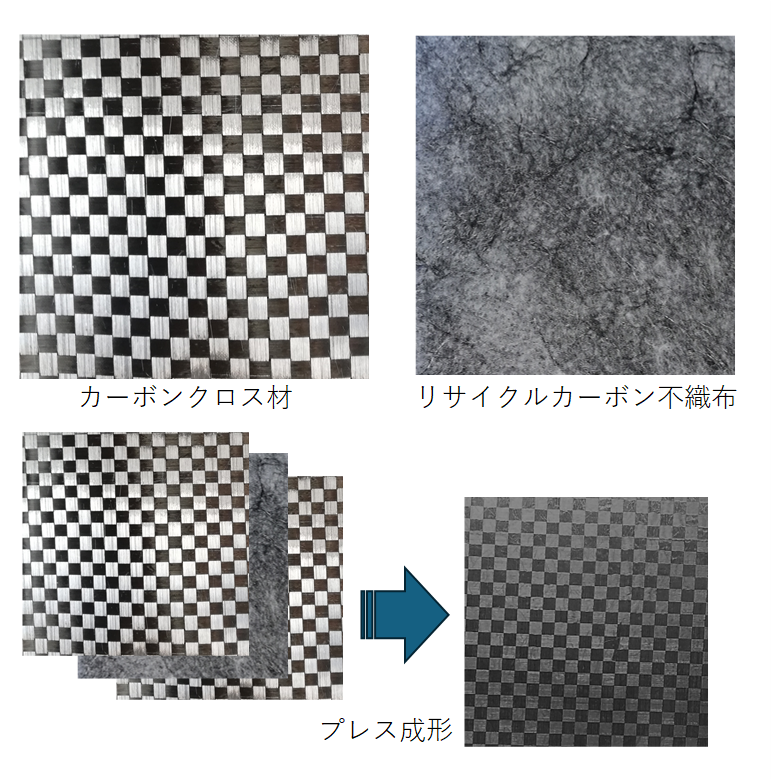
An effective solution for achieving both design quality and mechanical performance is a sandwich structure, where nonwoven material is layered between woven carbon cloth materials.
By placing woven fabric made from the same matrix resin on the outer surfaces:
The exterior gains the aesthetic texture of woven carbon fabric.
The interior benefits from the quasi-isotropic reinforcement effect of the nonwoven layer.
This configuration improves not only surface appearance but also bending stiffness and durability.
Example: PA6-Based Recycled Carbon Composite
In one case, a board was molded using:
A core material of recycled carbon nonwoven fabric with PA6 resin as the matrix
Carbon woven cloth using the same PA6 resin placed on both outer surfaces
Using the same resin system throughout enhances interlayer compatibility and provides excellent integration after molding. Even while utilizing recycled materials, this structure allows both appearance and performance to be achieved, depending on application requirements.
Expanding Design Possibilities with Recycled Carbon
Press molding with recycled carbon nonwoven fabric is a technology that balances environmental responsibility with product performance, expanding design options for composite applications.
By optimizing material configuration and laminate design according to performance requirements, this approach can be applied across a wide range of industries. Consulting from the prototyping and material evaluation stages enables the proposal of the most suitable molding methods and structures.
If you are considering molding with recycled carbon nonwoven materials or evaluating them during the prototyping stage, please feel free to contact us.
We support everything from process proposals tailored to your application to prototyping and mass production.

Company info
| Company name | Kawamura Kikai Co., Ltd. | EMIDAS Member Number | 105383 |
|---|---|---|---|
| Country | Japan | Street address |
Itabashi-ku Tokyo Japan |
| Telephone number | +81-3-3962-0415 | Fax number | Log in to display |
| Employees | 64,000,000 JPY | Annual sales | |
| Employees | 50 | Person in charge | 河村 護 |
| Type of manufacturing | Industrial machinery / Transportation equipment | ||
| Primary clients |
|
||